
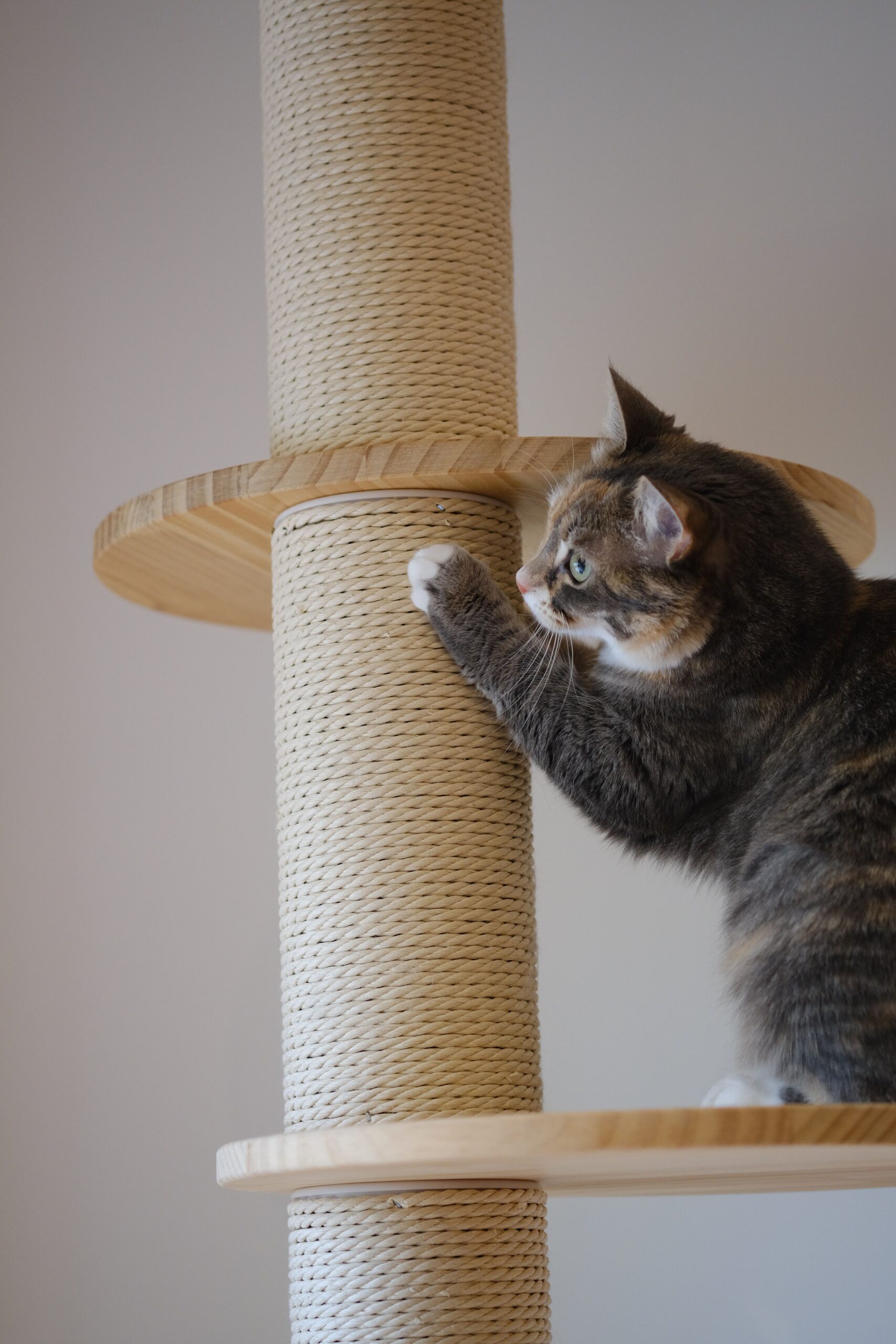
You buy a scratching post, put it in the corner, and congratulate yourself on being a responsible cat owner. Your cat walks past it, stretches, and enthusiastically attacks the arm of your sofa instead. Apparently, the furniture was the better offer.
Before you take it personally, here’s the good news: scratching is completely normal cat behavior. Your cat isn’t plotting against your living room. The trick is to understand what makes a surface appealing and give them a better place to do what comes naturally.
Why do cats scratch things in the first place?
Scratching does more than keep claws in shape. It helps cats stretch, remove old outer claw sheaths, and leave visible and scent marks in places that matter to them. That’s why you might notice scratching after a nap, near a doorway, or beside a favorite resting spot.
Scratching is not a bad habit to eliminate. It’s a normal need to accommodate. The Ohio State University Indoor Pet Initiative recommends offering suitable scratching surfaces and recognizing that some cats prefer vertical posts while others prefer horizontal pads.
The sofa has something the scratcher doesn’t
Imagine that your cat prefers to stand tall and pull down against a rough, sturdy surface. Now imagine the scratching post you’ve provided is short, wobbly, and tucked behind a table. The sofa arm is firm, tall enough for a stretch, and right in the middle of the room. It’s not surprising which one wins.
A good scratcher isn’t necessarily the fanciest one. It’s the one that matches your cat’s preferences: height, texture, stability, angle, and location. VCA Animal Hospitals notes that posts should be tall and stable enough for a full stretch and that placement matters.
1. Watch how your cat scratches
Rather than guessing, spend a day or two noticing what your cat actually chooses. Do they stand on their back legs to scratch the sofa’s side? Work their claws into a horizontal rug? Stretch toward the lower corner of a chair?
That little bit of detective work tells you whether to try a vertical post, a flat cardboard scratcher, or an angled surface. If you live with more than one cat, don’t assume they will all agree on the same style.
2. Put the new scratcher where the action is
The classic mistake is putting a new scratcher somewhere tidy and out of the way. Your cat may want to scratch in a meaningful, high-traffic location instead. Start by placing an appealing scratching surface right next to the furniture they already use.
Try an additional scratcher near a favorite sleeping place. Cats often stretch and scratch when they wake up. Once your cat is using the new surface consistently, you can experiment with moving it a little at a time—though some cats will always prefer it exactly where it is.
3. Choose stable and satisfying over stylish
A tall post that tips over when a cat leans into it is unlikely to win many fans. Look for a broad, stable base and enough scratching space for your cat to fully extend their body. Sisal, sturdy cardboard, and other cat-appropriate textures appeal to different cats.
You don’t need to turn your home into a cat furniture showroom. Start with one good match for the behavior you’ve observed, then add a different style if needed. A small home with two well-placed scratchers can be more useful than a collection of ignored ones.
4. Make the right choice easy—and rewarding
If your cat explores or scratches the new surface, reward that choice with a calm compliment, a favorite toy, or a suitable treat. You can make the scratcher interesting with a toy played around it, so your cat discovers the texture on their own.
Avoid grabbing your cat’s paws and dragging them down the post. It can make the surface unpleasant rather than inviting. And avoid shouting, spraying water, or frightening them when they use the sofa. Cornell’s Feline Health Center explains why punishment isn’t a useful way to teach a better scratching location.
5. Protect the furniture while a new habit forms
For the short term, protect the appealing sofa corner with a pet-safe cover or furniture protector that your cat can’t chew or swallow. Put the scratcher right beside it so there is an obvious alternative. Check any adhesive protection product against its instructions and your cat’s tendency to lick or chew materials.
The aim is to make the furniture less rewarding while the designated scratcher becomes more familiar. Covering every surface without providing a good alternative isn’t a long-term solution.
6. Don’t forget routine claw care
Regular claw checks can help you spot overgrown or damaged nails, particularly in older cats who may be less active. Ask your veterinarian or groomer to show you how to trim claws safely if you’re unsure. Trimming is different from declawing, which removes more than just a claw and is not a humane behavior shortcut.
If scratching suddenly changes, your cat seems uncomfortable, or a long-time favorite post is suddenly ignored, speak to your veterinarian. Pain, mobility problems, and other health changes can affect scratching behavior.
Try this three-day sofa-saving experiment
- Day one: Notice the direction, height, and location of the scratching your cat already does.
- Day two: Put a stable matching scratcher beside that spot and let your cat investigate at their own pace.
- Day three: Reward any use of the new surface, protect the problem furniture temporarily, and adjust based on what your cat actually chooses.
Three days may not change a long-established preference. Think of it as a way to learn what works, not a countdown to a guaranteed result. Keep experimenting patiently and ask a qualified feline behavior professional for help if the behavior remains difficult to manage.
A cat-friendly home doesn’t have to be a scratched-up home
The goal isn’t to convince your cat to stop being a cat. It’s to offer better options in places they already want to use. Once you look at scratching from your cat’s point of view, the sofa-versus-scratcher mystery becomes a little easier to solve.
Sources and further reading
- Ohio State University Indoor Pet Initiative — Scratching
- VCA Animal Hospitals — Cat Scratching Behavior
- Cornell Feline Health Center — Destructive Behavior
Featured image: Jasmine Pang / Pexels.